

The Rosenhan Experiment, Lived
From experiment to lived reality: psychiatry’s betrayal of trauma survivors

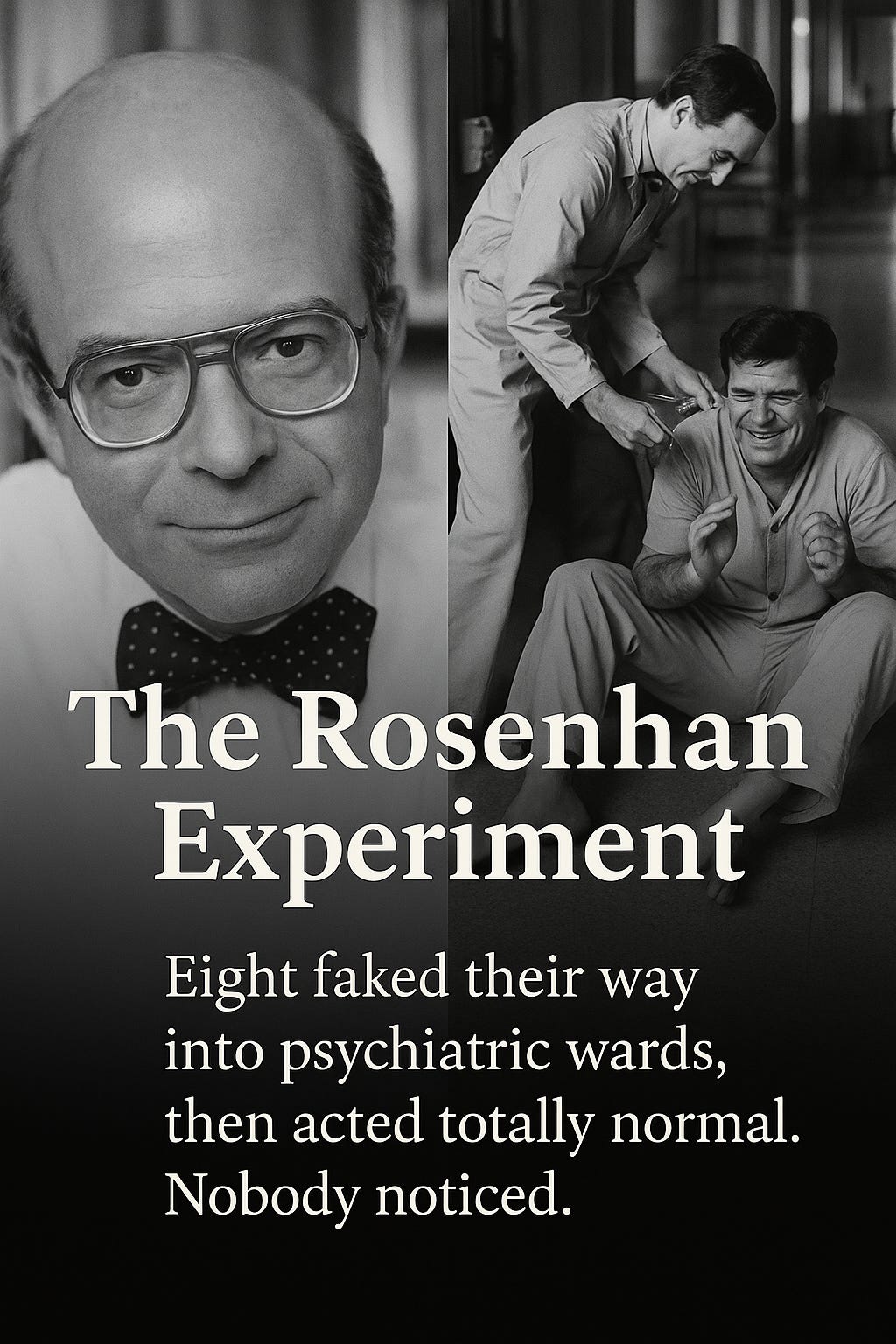
In 1973, psychologist David Rosenhan proved that psychiatrists couldn’t tell sanity from insanity. Eight healthy people faked a single symptom — hearing the word “empty.” Each one was admitted, diagnosed with severe mental illness, and locked inside.
Once labeled, every behavior — taking notes, flushing toilets, even being polite — was pathologized. Humanity disappeared behind diagnosis.
That was the experiment.
But for me, it wasn’t just history.
I lived it.
🧩 The Rosenhan Experiment (1973) — Summary
The Setup
Psychologist David Rosenhan recruited 8 sane “pseudopatients.”
They reported hearing one vague word — “empty” — to gain admission.
After being admitted, they acted completely normal.
The Results
All were diagnosed with mental illness (mostly schizophrenia).
They were kept from 7 to 52 days (average: 19).
The only way out was to admit being mentally ill and accept treatment.
Over 2,100 pills were prescribed; every one was pocketed and discarded.
Normal behaviors (note-taking, politeness, flushing toilets) were pathologized.
Ironically, patients saw the pseudopatients as sane, but staff did not.
The Fallout
When published in Science, it humiliated psychiatry.
One hospital challenged Rosenhan: “Send us your fakes, we’ll catch them.”
They later claimed to detect 41 imposters. Rosenhan had sent zero.
This exposed the paranoia and fragility of psychiatric labeling.
The Legacy
Coined the Rosenhan Effect: psychiatric labels distort reality for doctors and patients alike.
Contributed to asylum closures, the rise of patient rights, and reforms that shaped today’s DSM.
Left haunting questions:
If experts can’t tell sanity from insanity, what does that say about psychiatry itself?
How many lives have been destroyed by a false label?
The Takeaway
👉 Sometimes the scariest part of psychiatry isn’t the patients.
It’s the system itself.
Behind Locked Doors
After being raped, I spiraled into PTSD and homelessness. In desperation, I sought therapy — not pills, not labels, but care. Instead, I was branded, pathologized, and shuffled into group therapy with men just released from prison.
A traumatized woman, forced to sit in a locked room with men hardened by the system. My plea for safety filed away under mental illness.
The worst was the doors.
After being raped in a locked space I couldn’t escape, I now faced more locked doors in the place that promised healing. Every time the latch clicked behind me, panic surged. And I had to panic quietly, because if I didn’t, the threat was clear: they would hold me down and inject me with drugs.
I don’t know how that’s not rape itself. To be pinned down, penetrated by a needle, overridden in both body and voice — all under the name of treatment.
The Economics of Pathology
When I tried to tell the doctors what I needed — safety, gentleness, trust — they were unmoved. What concerned them most were the benefits they’d receive for each patient’s admittance and length of stay.
My trauma was their profit center.
My suffering, a billable unit.
My pain, a paycheck.
This is not care. This is commerce with a human face mask.
The Deeper Betrayal
Rosenhan’s pseudopatients could walk away eventually by confessing to an illness they never had. My escape was harder. I had to swallow labels, accept pills, and survive rooms that replayed my assault.
The danger of psychiatry isn’t just the pills, or the locked wards, or the endless diagnoses. The danger is in the blindness. Once labeled, you are no longer fully human.
Reclaiming the Story
Rosenhan published his results in Science, shaming psychiatry on a global stage. But my testimony is not an academic case study.
It is a lantern lit from the inside of the locked ward.
It is a voice that refuses to be silenced by labels.
It is the body saying: I am not broken. I am not your diagnosis. I am not your profit margin.
What psychiatry calls “care” often mirrors the original trauma: locked doors, unwanted penetration, voices dismissed, freedom stripped.
True healing doesn’t come from systems that mistake control for compassion. It comes from radical sovereignty, from trusting the body’s wisdom, from refusing to let institutions define the worth of a soul.